



Reliability as a Revenue Strategy
Strategic Insights for Technology Leaders Managing Business-Critical Systems
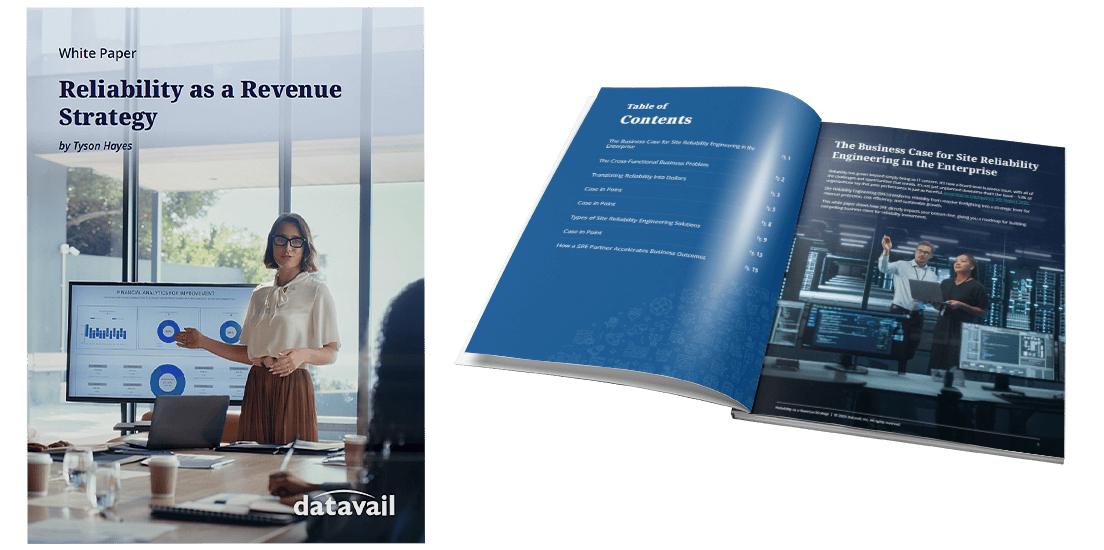
Are you facing mounting pressure to protect revenue while managing complex data and infrastructure estates? Understanding how to turn Site Reliability Engineering from a cost center into a strategic advantage is critical to keep both in balance.
Our guide helps you transform Site Reliability Engineering into a measurable business driver through data-backed strategies and real-world case studies.
What You’ll Learn
- How to quantify the financial impact of downtime and translate technical reliability metrics into executive-level business KPIs
- Five specific SRE solution categories that address everything from observability gaps to capacity planning challenges
- Real-world case studies showing how enterprise organizations achieved faster incident resolution and scalable operations
- A clear roadmap for building compelling business cases that connect reliability investments to revenue protection, cost efficiency, and competitive advantage
About the Author
Tyson Hayes leads Datavail’s Site Reliability Engineering practice, helping enterprise organizations transform reliability from reactive firefighting into strategic business advantage. With deep expertise in cloud architecture and observability frameworks, Tyson has guided technology leaders across healthcare, gaming, and financial services to build systems that scale with business growth while protecting revenue-critical operations.
Download the Full White Paper to Transform Reliability into Revenue Protection.
Frequently Asked Questions
What is Site Reliability Engineering and how does it differ from traditional IT operations?
Site Reliability Engineering (SRE) transforms reliability from reactive firefighting into a proactive engineering discipline. Unlike traditional IT operations that respond to incidents after they occur, SRE uses software engineering principles to automate operations, prevent failures before they impact users, and measure reliability through clear business metrics.
How do I calculate the actual cost of downtime for my organization?
Calculate downtime costs by multiplying your hourly revenue by the percentage of revenue-bearing flows affected, then add indirect costs like customer acquisition impact and SLA penalties. For enterprises, direct revenue loss ranges from $300,000 to $5 million per hour depending on company size and industry. However, total cost includes brand reputation damage (which increases customer acquisition costs), lost productivity across affected teams, regulatory penalties in industries like healthcare and financial services, and the opportunity cost of engineers firefighting instead of delivering features.
How do I prioritize reliability investments when everything seems critical?
Use Service Level Objectives (SLOs) and error budgets to make reliability decisions based on business impact rather than subjective judgment. Start by mapping customer journeys to technical systems, then establish SLOs for each journey based on actual business requirements—not arbitrary uptime targets. Revenue-critical flows like checkout or transaction processing warrant higher SLOs and more resilience investment, while internal tools can operate at lower reliability thresholds.
Download the White Paper