Data Strategy & Analytics Forum Summer 2026 Event Recap
Author: Jeff Schodowski | 7 min read | July 22, 2026
Earlier this month, I spent a few days at the VISIONS Data Strategy & Analytics Forum talking with data and technology leaders across industries. One theme surfaced in nearly every conversation: AI budgets are climbing, business expectations are climbing faster, and progress is still slower than plan.
The most insightful conversation I had all week wasn’t at a booth or a networking break. It was the fireside chat I led onstage with Joseph Degrave, Director of Technical Delivery at Hertz. We walked through what enterprise data transformation actually looks like inside a company running real ERP, fleet, customer, finance, and operational systems, and we shared the practical scorecard that separates data programs that move the business from those that just produce more dashboards.
Inside the Fireside Chat: From Data Chaos to Business Clarity
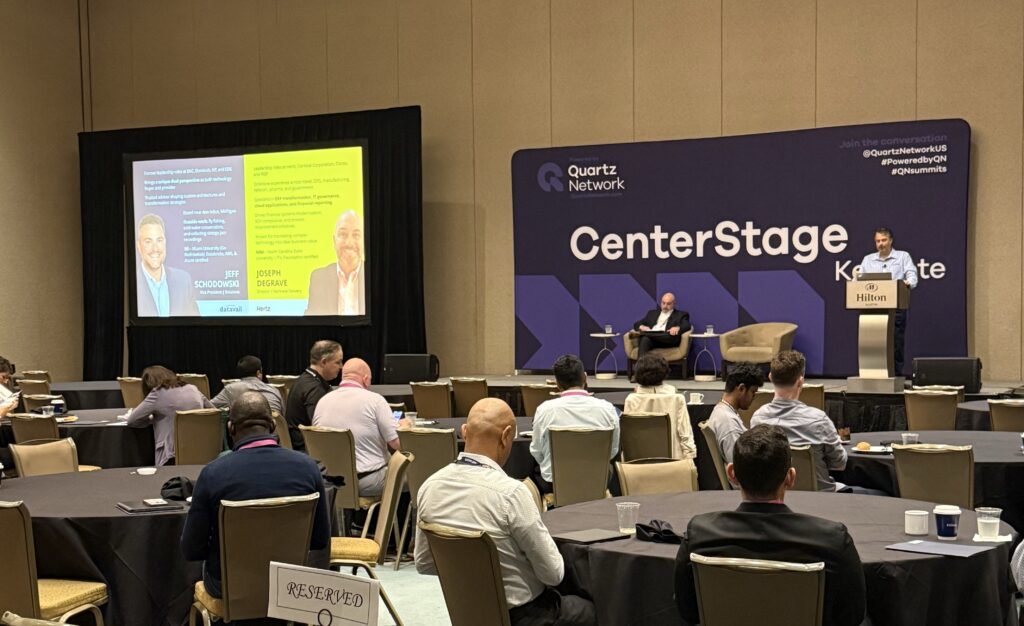
We focused the session on what enterprise data transformation looks like in practice. Real systems, real friction, real outcomes.
The Reality Check
I opened by naming the moment most companies are in.
“AI exposes data issues, it doesn’t fix them.”
Teams still spend significant time reconciling data before leadership decisions can be made. Confidence in the data itself is what’s missing, and that gap shows up most clearly when companies try to move pilots into production.
“Trust, not technology, is the real constraint.”
What Breaks Inside the Business
Hertz offered a clear-eyed view of how this plays out across ERP, fleet, customer, finance, and operational systems. Different teams define KPIs differently. Workarounds creep into every reporting cycle. Decisions get delayed while data gets cleaned up after the fact.
Three patterns emerged from Joseph’s environment:
- Siloed systems producing conflicting KPIs
- Business and IT misalignment that erodes trust in the numbers
- Constant reconciliation work that drains time and creates real opportunity cost
None of those problems get solved by adding another tool.
A Practical Path Forward
We walked the audience through the approach I rely on with enterprise clients today:
- Discovery: Map where data lives, how it moves, and which elements matter most to the business.
- Standardization: Align definitions, retire duplicates, and clean up inconsistencies.
- Governance: Assign clear ownership and make data quality something you can measure.
- Operationalization: Embed trusted data into the workflows where decisions actually happen.
- AI activation: Focus models and agents on use cases tied to measurable business outcomes.
“AI is just the final mile of a much longer data journey.”
What Most Teams Underestimate
Even with the right architecture in place, transformation efforts often stall for non-technical reasons. I called out three during the talk:
- Leading with tools before defining the business problem
- Lack of clear ownership on the business side
- No real adoption strategy for new ways of working
That mismatch led to a line I think hit hardest with the room.
“If users don’t change decisions, you haven’t created value, you’ve just created visibility.”
Better dashboards alone don’t move the business. Better decisions do.
Measuring What Actually Matters
A common mistake I see is measuring data programs purely on technical metrics. I made the case onstage for a different scorecard, one tied directly to the business:
- Decision cycle time
- Share of decisions made with trusted data
- Reduction in manual reconciliation work
- Revenue or cost impact tied directly to AI use cases
Data platforms and models are the means. Decisions are the point.
AI is Sprinting Ahead of the Data Behind It
Throughout the conference, I had chat after chat where leaders described AI use cases already running in production. Automation, advanced analytics, agentic workflows. The tooling is moving fast.
What became clear is that those initiatives are surfacing problems that existed long before AI arrived. When data is inconsistent or poorly defined, AI doesn’t quietly route around the gap. It widens it. The path to better AI outcomes, for nearly everyone I spoke with, starts well upstream of the model.
Governance Tools Aren’t the Same as Governance
Most of the leaders I met had already invested in cataloging, lineage, or metadata platforms. Even so, data and AI governance came up again and again as the biggest blocker to scale.
The friction is execution. I heard the same themes repeatedly: unclear ownership across business units, conflicting definitions for the same metric, inconsistent quality standards, and governance processes disconnected from the actual flow of work.
Fragmentation Is Still the Default State
Almost everyone I spoke with sits somewhere in the middle of a multi-year modernization effort. Teams continue to work from different sources, different definitions, and different versions of the truth. Integration takes more effort than expected. Reconciliation eats into time that should go toward decisions.
I lost count of how many leaders told me some version of the same thing: too many dashboards, not enough clarity.
Data Quality Quietly Limits Business Momentum
Nobody I met disagreed that data quality matters. Far fewer have managed to make it a real priority. It tends to lose budget battles against more visible initiatives, even though it underpins almost all of them.
The cost shows up in three places, and I heard about all three:
- Weaker confidence in reporting
- Slower adoption of analytics tools
- AI projects that stall before they scale
Better data quality is one of the highest leverage moves a business can make. It’s also one of the most often deferred.
Modernization Is Underway, But Direction Often Isn’t
There’s clear momentum toward modern data platforms. What I heard far less often was a confident answer about the path forward. Decisions around architecture, integration, vendor strategy, and cost are all happening at once. Competing priorities pull teams in different directions every quarter.
The teams making the most progress treat modernization as a business program rather than a technology project. They tie every architectural choice to a measurable outcome the business cares about.
Stretched Teams Are Slowing the Whole Engine
Even when strategy is clear, capacity rarely is. Data teams I met are juggling operations, modernization, governance, and AI at the same time. Leader after leader told me the same thing: they know what needs to happen, they just don’t have the bandwidth to do it well.
That’s where outside support, focused on outcomes rather than activity, can shift the curve.
Where the Best Organizations Are Focusing Next
The companies making real progress have stopped buying more tools and started solving the underlying problems. Their priorities are remarkably consistent:
- Clear ownership and accountability for data
- Consistent, measurable data quality
- Integration across systems and business units
- Direct alignment between data initiatives and business outcomes
- A foundation designed to scale analytics and AI
When the foundation works, the rest of the business moves faster. I saw plenty of evidence of that at VISIONS this year.
How My Team and I Can Help
If any of this sounds like your environment, the next step probably isn’t another platform. It’s a sharper view of where your data is helping the business and where it’s holding it back.
At Datavail, my team works with enterprise leaders to:
- Strengthen data quality and trust
- Establish governance that fits how teams actually work
- Modernize data platforms with business outcomes in focus
- Prepare data foundations to support analytics and AI at scale
If you’d like to compare notes on what I heard at VISIONS, or talk through where your own data foundation stands today, I’d welcome the conversation. Reach out and let’s set up time.