


What’s the True Cost of Your Legacy Applications?
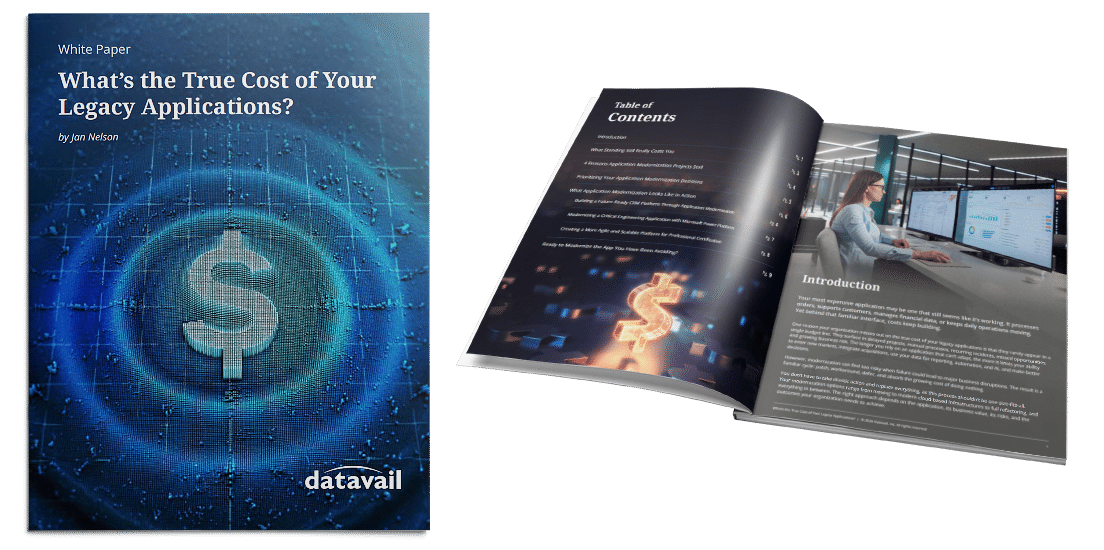
Your legacy application processes orders, supports customers, or keeps daily operations moving. On the surface, it appears to be doing its job. Behind the scenes, the costs continue to grow.
Extended support, manual workarounds, security exceptions, recurring incidents, and delayed projects rarely appear in one budget line. Yet together, they consume resources, increase business risk, and make it harder to use your data for reporting, automation, and artificial intelligence.
This white paper helps you identify those hidden costs, prioritize applications for modernization, and choose an approach based on business value, technical condition, and the outcomes you need.
What You’ll Learn
- Where the true costs of legacy applications hide across infrastructure, support, security, incidents, and manual work.
- Why modernization projects stall and how better visibility into dependencies, downtime requirements, and total costs can move them forward.
- How to prioritize applications using business value and technical condition.
- How organizations have modernized critical applications with Microsoft Azure.
Fill out the form on this page to learn how to expose the costs that traditional budgets miss, identify the applications that deserve attention first, and build a modernization roadmap around measurable business priorities.
Frequently Asked Questions
Why do application modernization projects stall?
Modernization can slow down when stakeholders do not share the same view of the application, dependencies surface late, downtime windows are limited, or the business case excludes important costs and benefits.
How should we prioritize legacy applications?
Evaluate each application based on its business value and technical condition. Business value includes its effect on revenue, service, compliance, productivity, and strategic initiatives. Technical condition includes security, reliability, support status, maintainability, architecture, skills, and cost.
Does every legacy application need to be replaced?
No. High-value applications in strong technical condition may only need optimization or a move with limited changes. Low-value applications in weak condition may be better candidates for retirement, consolidation, or replacement.
Download the White Paper